

An earnout makes part of a business-sale payment depend on an agreed future outcome. Its maximum amount is potential consideration; it is not money you can assume you will receive. The International Business Brokers Association describes an earnout as future consideration linked to the business reaching specified performance criteria. (IBBA glossary)
For an iGaming seller, the useful question is whether you can explain how the proposed arrangement would work after the buyer takes control. What is measured, who can affect it, how will you verify it, and when would you be paid?
A higher potential price can be worth considering. First make the exposure understandable enough to compare with your exit goals and the rest of the offer.
Start with the calculation, using ordinary language
Ask the buyer to show the formula with several outcomes: below target, at target and above target. Identify the measurement period, threshold, rate, floor and cap. If the proposal uses a different structure, such as an all-or-nothing payment, show that difference explicitly.
Then define the metric. Revenue, profit, traffic and customer retention measure different things. Even a familiar label such as “annual affiliate revenue” leaves open the treatment of operator deductions, adjustments, currencies and the timing of recognition.
Player deposits, an operator's gaming revenue and the affiliate income earned by your business are different amounts. The earnout should identify which records and calculation determine the figure being tested.
A hypothetical capped earnout
Assume an invented earnout pays 50% of defined annual revenue above €1,000,000, with a zero floor and a €200,000 cap. Let R mean revenue for the agreed twelve-month measurement period, calculated under the definitions in the agreement.
The illustrative payment is the smaller of €200,000 and 50% of the amount by which R exceeds €1,000,000, with a minimum payment of zero:
Payment = min(€200,000, max(€0, 0.5 × (R − €1,000,000))).
| Defined revenue R | Illustrative earnout |
|---|---|
| €900,000 | €0 |
| €1,000,000 | €0 |
| €1,200,000 | €100,000 |
| €1,400,000 | €200,000 |
| €1,600,000 | €200,000 |
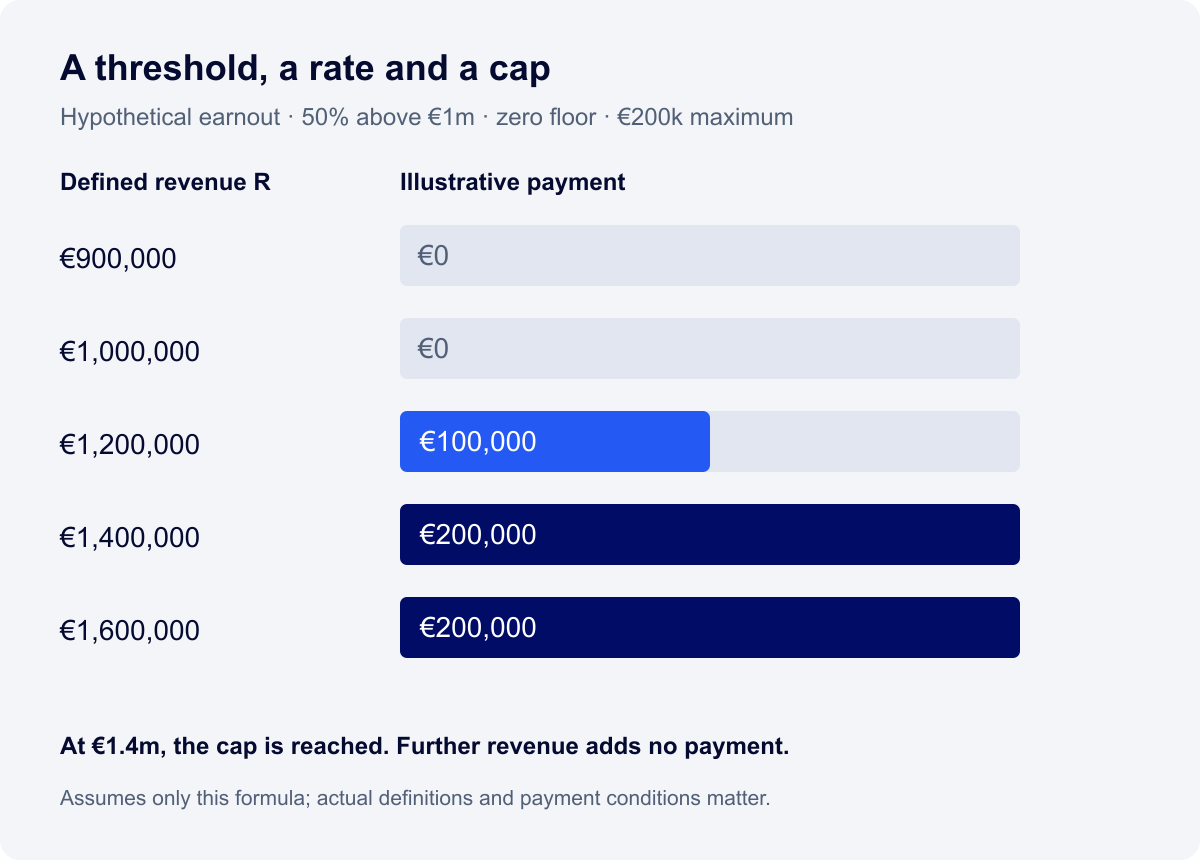
These figures are hypothetical, not forecasts, recommended terms or evidence of iGaming market practice. They isolate one formula and assume no other payment conditions or adjustments. Actual drafting can produce a different result, and a calculated amount still has to become payable and be collected.
The table reveals the shape of the proposal. Revenue below the threshold produces no earnout. Above €1,400,000, additional revenue produces no further payment under this particular formula. That is useful information when judging the responsibilities you are being asked to retain.
Work through an affiliate-specific definition problem
Suppose an affiliate business reports €1,200,000 for the measurement period. In a hypothetical example, €80,000 relates to amounts later reversed or deducted by operators. One draft calculation includes them; another excludes them.
Under the formula above, €1,200,000 produces €100,000. If the agreed definition instead produces €1,120,000, the result is €60,000. The €40,000 difference comes from the definition, even though the percentage and threshold are unchanged.
This example does not prescribe how deductions should be treated. It shows why the parties need to resolve the treatment, source records and cut-off date before relying on the headline formula. The same exercise should identify how late adjustments are handled and when a calculation becomes final under the agreed process.
Attribution deserves equal attention. If the buyer combines reporting across its own sites and yours, how will the acquired business's income be identified? If operator agreements or account structures change, which records will support the earnout calculation? Ask for a worked example using the proposed reporting method, not just a promise that the information will be available.
Match operating control to the proposed exposure
List the decisions that could affect the metric. For an affiliate business, these may include content expenditure, site migrations, traffic strategy, operator selection and commercial terms. For a software supplier, they may include product integration, pricing, customer allocation and support resources.
Record who will make each decision after completion. If you remain involved, distinguish the ability to advise from the authority to decide.
A profit-based metric needs particular attention to the costs charged to the acquired business, including shared services and integration work. A revenue-based metric still requires decisions about attribution and adjustments. Neither label removes the need to examine the actual calculation.
Ask your advisers how the proposed agreement addresses these issues, which commitments can realistically be made and what happens if the buyer's plans change. Do not assume that historic performance will continue under a different operating model.
Test reporting and payment before signing
Choose a sample month and work through the whole proposed process. Start with the source reports, apply the definitions, produce the calculation, raise a sample disagreement and identify the payment date.
This exercise should answer practical questions:
- Which reports can you inspect, in what detail and how often?
- Who prepares the calculation and explains adjustments?
- How long do you have to review or challenge it?
- Who resolves a disagreement, and which issues can they decide?
- When is payment due, and are there other conditions, retentions or set-off provisions to review?
The reporting period and payment date are separate matters. “Measured over twelve months” does not tell you when the cash reaches you.
Your accountant should review the measurement mechanics, while your lawyer reviews the relevant rights, obligations and dispute process. The commercial aim is a calculation both parties can follow, supported by records the agreed process allows you to inspect.
Define your work separately from the earnout
An earnout does not, on its own, describe your job after the sale. Set out any handover, advisory, consultancy or operational responsibilities separately: tasks, availability, authority, compensation and endpoint.
Suppose a buyer wants you to keep handling operator relationships while its own team controls content investment. That may be workable, but the division of responsibilities must be visible when you assess a revenue target. Do not accept responsibility for an outcome without understanding which decisions belong to someone else.
Also consider whether the role fits your reason for selling. An owner who wants to leave daily operations may view the arrangement differently from an owner who enjoys the commercial work and wants a gradual transition.
Take six questions into the next discussion
| Area | Question to answer before deciding |
|---|---|
| Metric | Can we reproduce the number from named records using agreed definitions? |
| Formula | What happens below target, at target and above the cap? |
| Control | Which buyer and seller decisions can change the outcome? |
| Information | What can I inspect, and how are adjustments or disagreements handled? |
| Payment | When would the amount become due, and what could affect collection? |
| My role | What work am I accepting, with what authority and endpoint? |
Compare the answers with completion cash, other deferred amounts and your personal plans. Our iGaming affiliate valuation guide shows why an assessed business value and the money available to a seller are different figures.
You may conclude that the earnout is worth negotiating, that its definitions need work, or that the exposure does not suit your goals. A useful next step is to identify the one unresolved term most likely to change that conclusion.
Chapters 7, 12, 15 and 16 of The iGaming M&A Handbook connect payment structure, negotiation, transaction documents and post-sale involvement. You can explore the contents and request a complimentary PDF.
If you would like to organise the commercial questions around a proposed earnout, you are welcome to contact me privately. You can start with the structure and the decision you are facing without sending sensitive deal documents.