
By Tobias Regnestam, founder of Bravio Brokerage
An iGaming affiliate business is valued on the earnings a buyer could sustain, the risks attached to them and the terms of the sale. Start with verified earnings after the costs needed to run the business, then test an appropriate multiple against relevant evidence. The headline valuation and the amount paid to the seller can be different.
An affiliate business with €600,000 in annual revenue might produce very different outcomes for a buyer depending on its costs, operator relationships, traffic and reliance on its owner. Even “€180,000 in profit” leaves important questions open. Which costs have been included? Who does the work? What changes when you leave?
This is the approach behind the valuation chapter of The iGaming M&A Handbook. The hypothetical affiliate business below shows which information changes the answer.
1. What earnings are we valuing?
Start with a defined period and reconcile the figures to the accounts. For an initial discussion, prepare monthly results for the latest complete twelve months, with earlier periods alongside them to explain trends and unusual movements.
Revenue needs a clear definition too. Show the affiliate income the business earns, separated by operator and revenue model. Keep player deposits, stakes and an operator’s gaming revenue distinct from your affiliate revenue.
Then work through the costs: content, paid traffic, hosting, software, contractors, staff and the owner’s work. A buyer needs to understand what it takes to keep that income coming in.
A worked earnings bridge
Suppose the business reports €600,000 annual revenue and €180,000 EBITDA. EBITDA means earnings before interest, tax, depreciation and amortisation. In this example, it already includes an €80,000 cost for the working owner and a documented €10,000 expense that will not recur.
The owner’s €80,000 and the assumed replacement cost below both include salary, employer charges and benefits. There are no other adjustments in this simplified example.
| Step | Adjustment | Annual earnings |
|---|---|---|
| Reported EBITDA, after the owner’s employment cost | Starting point | €180,000 |
| Remove the documented one-off expense | +€10,000 | €190,000 |
| Remove the working owner’s employment cost | +€80,000 | €270,000 |
| Allow for the full cost of replacing the owner’s work | −€60,000 | €210,000 |
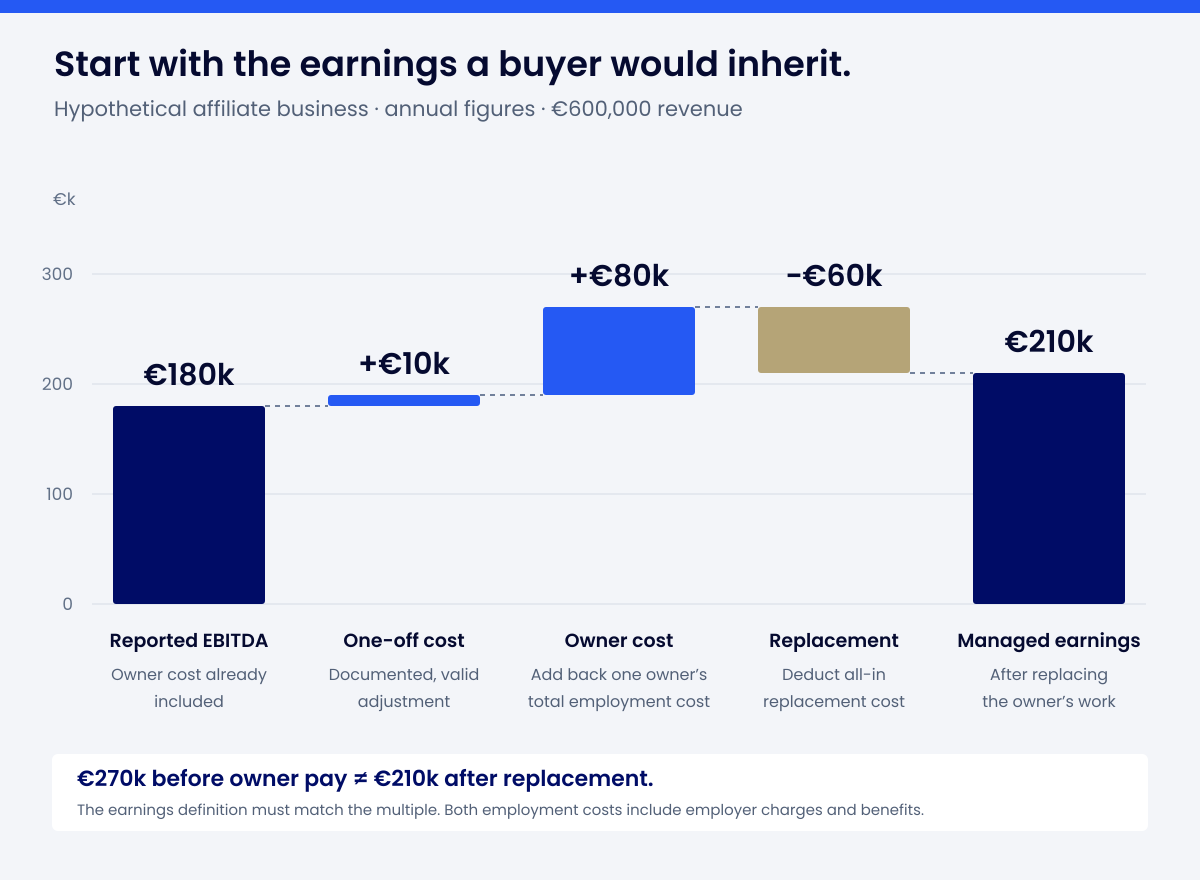 View larger chart
Read chart summary
Hypothetical annual EBITDA €180,000 plus €10,000 one-off cost plus €80,000 owner employment cost minus €60,000 replacement employment cost equals €210,000 managed earnings.
These figures describe different things:
- €190,000 is an interim adjusted figure, before normalising the owner’s compensation.
- €270,000 is an SDE-style figure: earnings available before paying one working owner, under the stated assumptions. SDE means seller’s discretionary earnings.
- €210,000 is earnings after owner replacement, called managed earnings for this example.
These are earnings measures, not cash available to the owner. Tax, capital expenditure, working-capital needs and financing can change cash flow.
The distinction matters. A buyer intending to do the owner’s work personally and a buyer intending to hire someone have different operating plans. The International Business Brokers Association distinguishes discretionary earnings before one owner’s compensation from earnings normalised for replacement compensation. (1)
The replacement cost needs evidence. Write down the responsibilities, hours, skills and relationships involved, then investigate what it would cost to cover them. One salary may not replace everything the founder does.
Adjustments need the same discipline. A cost should not disappear from the calculation merely because you dislike paying it. Recurring content production and necessary maintenance still need funding. Remove exceptional income as well as considering justified expense adjustments, and never add back a dividend that was not an expense in the first place.
I would ask your accountant to check this bridge before using it with buyers. It is much easier to discuss a multiple when everyone can follow the number underneath it.
2. How dependable and transferable are those earnings?
Two businesses can arrive at the same €210,000 and still present very different risks. The useful next step is to examine the evidence behind the income and what must remain in place for it to continue.
Traffic: explain what brings in the revenue
Break traffic down by channel, landing page and country, then connect it to conversions and affiliate income where the data allows. Show changes over time. A total visitor count can hide a business that depends on a handful of commercially valuable pages.
For an SEO business, explain which pages and queries matter and what has changed. For a paid-traffic business, show earnings after media spend and the other costs of running the campaigns. In either case, distinguish the facts from your explanation of the cause.
If traffic has fallen, provide a clear timeline, the revenue effect and the actions taken. An annual average can hide a recent change that matters to the buyer.
Operator income: look underneath the revenue model
Revenue share deserves a closer look than its label. Where records permit, show how income from earlier player cohorts has developed and how much depends on continuing acquisition. Explain deductions, payment differences and concentrations by operator and country.
Alongside the numbers, collect the actual agreements and amendments. Which entity holds the relationship? What happens under an asset sale or a change of control? Is consent required? What has the operator confirmed?
A good commercial relationship is useful evidence about how the business runs. The documents and relevant approvals determine what needs to happen in a transaction. Have the specific terms reviewed instead of assuming the revenue automatically follows the website.
Before assuming revenue will continue, review our guide to operator agreements and consent in a casino affiliate sale.
Operations: make the work visible
Show who handles content decisions, SEO, campaigns, operator discussions, payment reconciliation and reporting. Identify the duties that come back to you, even if they take only a few hours each week.
Documented processes, clear ownership of domains and content, suitable team arrangements and a defined handover help a buyer assess continuity. They also make the replacement-cost estimate more credible.
Growth: describe a funded next step
“There is plenty of potential” gives a buyer little to evaluate. A useful opportunity has evidence, a specific action, required skills, an estimated cost and a reason it has not already been pursued.
Keep existing performance separate from a buyer’s possible improvements. A strategic buyer may see benefits from its own capabilities, but those benefits do not automatically become part of the price it will pay you.
What does this mean for the multiple?
It gives you the material needed to assess relevant comparisons. Check the earnings definition, measurement period, business model, scale, traffic trend and transaction terms. An advertised asking price does not establish what a buyer ultimately paid.
Monthly or annual earnings? Using the same definition and twelve-month period, €210,000 annual earnings equals €17,500 average monthly earnings. The illustrative 4× annual input below is equivalent to 48× average monthly earnings: both give €840,000. This is arithmetic, not a market benchmark. Changing the time unit does not make SDE, EBITDA and earnings after owner replacement interchangeable.
For our hypothetical business, we can test the arithmetic using €210,000 managed earnings:
| Chosen annual multiple | Illustrative enterprise value |
|---|---|
| 3× | €630,000 |
| 4× | €840,000 |
| 5× | €1,050,000 |
The 3×, 4× and 5× inputs are chosen for illustration. They are not current iGaming market benchmarks, observed offers or a suggested valuation range for your business.
The table shows sensitivity to an assumption. To choose an evidence-based range, you need relevant, current transaction information on the same earnings basis, then assess the differences. A multiple quoted on SDE cannot simply be carried across to managed earnings. (2)
You can also test the earnings assumption. At the illustrative 4× input, a €20,000 change in sustainable annual earnings changes the calculation by €80,000. That makes the cost of maintaining the business worth examining carefully before debating small differences in the multiple.
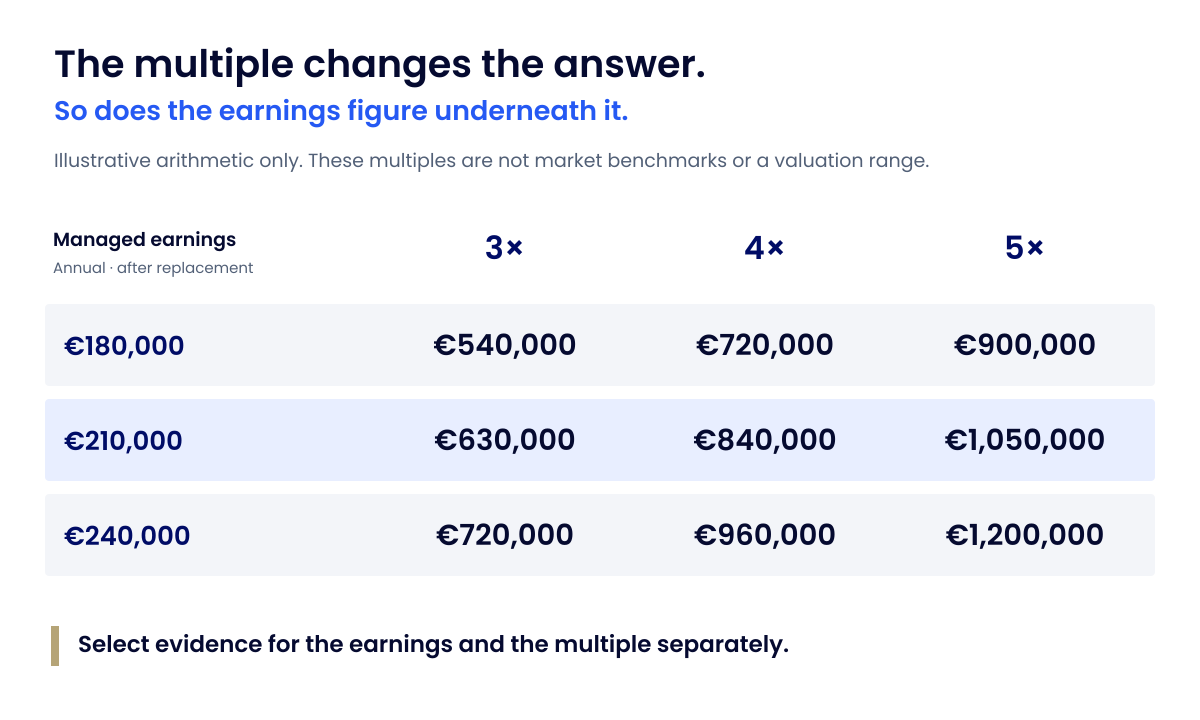 View larger chart
Read chart summary
Hypothetical enterprise values from assumed annual managed earnings of €180,000, €210,000 and €240,000 multiplied by 3, 4 and 5. The central row gives €630,000, €840,000 and €1,050,000. These are not market benchmarks.
3. What would the proposed deal actually pay you?
A business valuation and the cash reaching the seller are different numbers. First establish what the proposed price represents and which assets, liabilities and obligations are included.
Enterprise value describes the value of the business operations. The basic relationship is enterprise value equals equity value plus net debt. (3) In a share-sale example, the contract must define the treatment of cash, debt and other adjustments, including working capital.
Suppose our hypothetical share sale uses the €840,000 enterprise value from the middle sensitivity calculation:
| Illustrative share-sale bridge | Amount |
|---|---|
| Agreed enterprise value | €840,000 |
| Add cash included in the agreed price bridge | +€40,000 |
| Deduct debt included in the agreed price bridge | −€100,000 |
| Deduct the agreed working-capital shortfall | −€20,000 |
| Equity consideration before seller costs and tax | €760,000 |
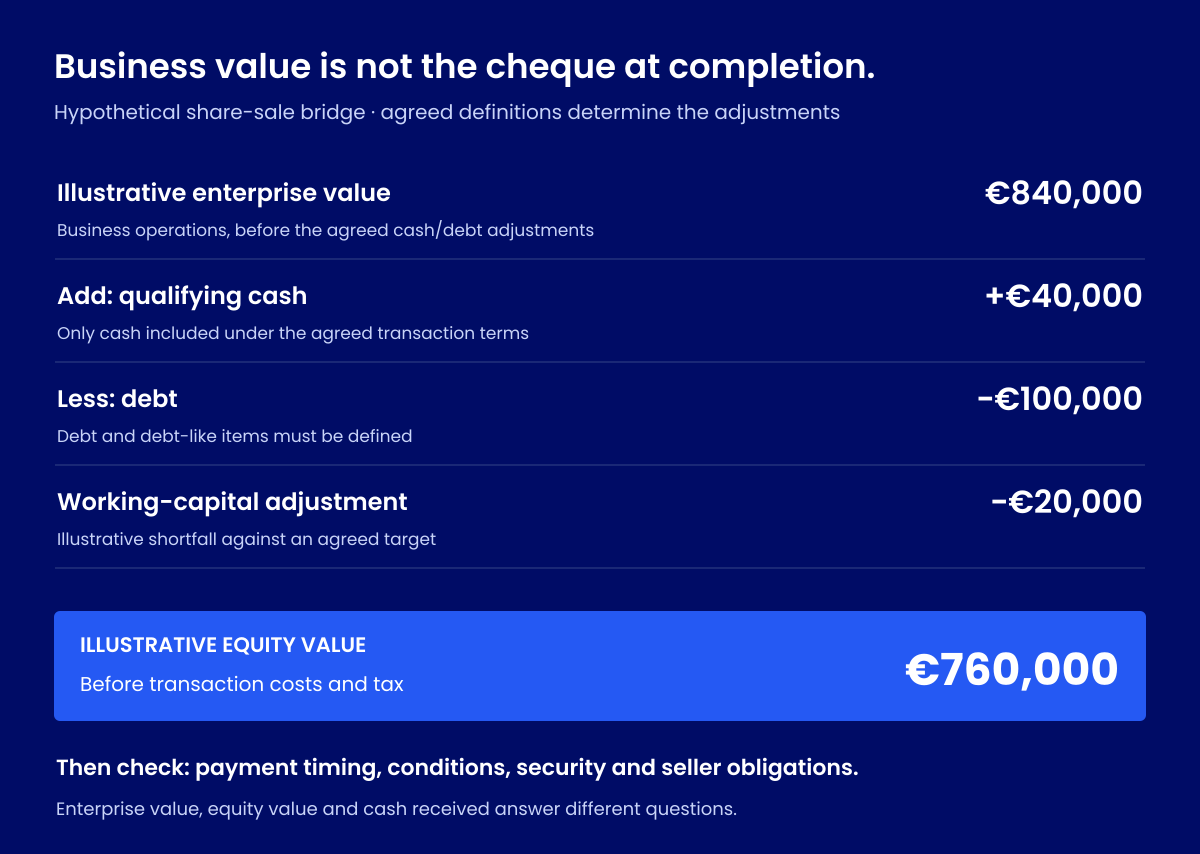 View larger chart
Read chart summary
Hypothetical enterprise value €840,000 plus €40,000 cash minus €100,000 debt minus €20,000 working-capital adjustment equals €760,000 equity value before seller costs and tax. Payment timing is separate.
The cash assumption does not mean all cash is available for extraction. The transaction needs an agreed approach to the funding required to operate the business, without counting the same item twice. An asset sale needs its own treatment; this share-sale bridge should not be copied across automatically.
Timing changes the outcome again. If the hypothetical €760,000 consists of €600,000 at completion and €160,000 in fixed deferred payments, only €600,000 is payable at completion, before the seller’s costs and tax. The later payment still carries collection risk.
An earnout adds performance conditions. If part of the price depends on future results, separate the maximum possible payment from amounts payable without those performance conditions. Examine the metric, accounting rules, buyer control, reporting rights and dispute process with your advisers.
I would put those terms beside your handover duties and any restrictions on your future work. A higher headline price can require more time, risk or ongoing involvement. The comparison needs to show all of that on one page.
Two examples from 2026 disclosures
In its 19 March 2026 filing, Gambling.com Group identifies search changes, AI-driven search and customers’ ability to terminate arrangements as business risks. These are the issuer’s disclosures, not a diagnosis of your website; they reinforce the need to examine actual traffic and agreements. (4)
In February 2026, Genius Sports announced a Legend acquisition structure of US$800 million cash and US$100 million stock at closing, plus up to US$300 million contingent consideration. The US$1.2 billion headline was neither all cash nor fully unconditional. It illustrates payment structure, not a comparable valuation for a smaller affiliate. (5)
Genius subsequently completed the acquisition on 30 April 2026. (6)
Common iGaming affiliate valuation questions
Do affiliate agreements transfer when I sell the website?
Do not assume they do. Check the specific agreement, amendments and sale structure, and obtain any required consent in writing. For example, Entain’s public terms require prior written consent for assignment or transfer. Your own operator arrangements determine what can move with the business. (7)
How does negative carryover affect the earnings?
Where the agreement allows negative carryover, a negative commission balance can reduce future revenue-share payments. Show the applicable terms and statement balances, then reconcile their effect on reported income and cash received. Do not assume every programme or account uses the same rule. (7)
Is revenue share worth more than CPA?
The label alone does not establish a higher value. CPA pays for a qualifying referral; revenue share pays a percentage of the referred players’ net gaming revenue; hybrid combines the two. Compare the actual income, costs and terms, including what earlier player groups still earn and what depends on new referrals. (4)
What if organic search traffic is declining?
Show when the decline began and how it affected affiliate income. Compare equivalent periods by page, query and country; check indexing, technical issues and changes in demand before assigning a cause. Keep an assumed recovery separate from the earnings already demonstrated. (8)
What to prepare before asking for a valuation
You can begin with a compact evidence pack:
- Monthly financial results. Reconciled revenue and costs, with explanations for unusual movements and supporting operator/payment records.
- An earnings bridge. Each proposed adjustment, its evidence and a separate estimate for replacing your work.
- A revenue map. Income by operator, country and revenue model, with concentration and recent trends visible.
- A traffic-to-income view. The channels and pages that matter commercially, including changes that an annual total could obscure.
- A continuity checklist. Agreements, consent questions, asset ownership, team responsibilities and handover requirements.
- Your deal priorities. The cash you need at completion, the uncertainty you can accept and the work you are willing to do afterwards.
Keep this material private until you have agreed who should receive it and at what stage. A first conversation can begin with a short description of the business and your question.
Chapter 7 of The iGaming M&A Handbook develops this valuation framework. Chapter 6 covers the preparation behind it, and Chapter 12 covers offers and negotiation. Together, they help you move from a headline number to a position you can explain and test. You can explore the contents and request a complimentary PDF.
For an overview of how Bravio supports owners through a sale, see selling a business. If you own an iGaming affiliate business and want to work through the commercial questions, you are welcome to contact me privately. Tell me the business model and what you are trying to understand; there is no need to send sensitive records with your first message. Your accountant and legal and tax advisers remain responsible for their specialist assessments.
Sources
-
Genius Sports — Legend acquisition announcement, 5 February 2026.
-
Google Search Central — Debugging drops in Google Search traffic.
Original sources checked 12 October 2026. The sources for the added questions were checked 19 October 2026. The numerical examples in this article are hypothetical.