

When two buyers offer different prices for your iGaming business, put the payment structure, conditions and future work on the same page before choosing a favourite. The higher headline price may leave you with less cash at completion and more exposure afterwards.
Start with three questions: what is each buyer buying, when could you receive the money, and what must you do to receive it? Those questions turn two impressive numbers into proposals you can actually compare.
The exercise should help you decide what to negotiate next. It does not require you to accept either offer.
First, check that the offers cover the same business
A comparison can go wrong before any arithmetic begins. One buyer may propose buying the company; another may want selected websites, domains and contracts. A buyer may include working capital in its price while another expects a separate adjustment.
For an affiliate business, list the sites, content, domains, operator relationships, reporting data and team arrangements under discussion. For a supplier, identify the software, intellectual property, customer contracts and support obligations. Ask the relevant advisers to establish what would actually transfer and which liabilities remain with you.
An offer that excludes an important asset, leaves an obligation behind or requires additional expenditure cannot be compared simply by putting its price beside another number.
Also establish whether each price describes enterprise value, equity consideration or a payment for specified assets. Our guide to valuing an iGaming affiliate business explains the bridge from business value to seller proceeds. Use the definitions in the actual proposal, then have the proposed adjustments checked.
Separate completion cash, later payments and contingent value
Use a separate line for every kind of payment. A fixed amount due later carries different questions from an earnout that depends on future performance. Neither should disappear inside a single “total value” figure.
A hypothetical two-offer comparison
The following offers are invented to illustrate payment structure. They are not actual transactions, market benchmarks or recommended terms. Assume identical transaction scope and price-adjustment assumptions. The amounts are before fees, tax and other adjustments.
| Payment component | Offer A | Offer B |
|---|---|---|
| Cash proposed at completion | €800,000 | €650,000 |
| Fixed deferred payment proposed after 12 months | €0 | €150,000 |
| Maximum performance-dependent earnout | €0 | €300,000 |
| Total possible consideration | €800,000 | €1,100,000 |
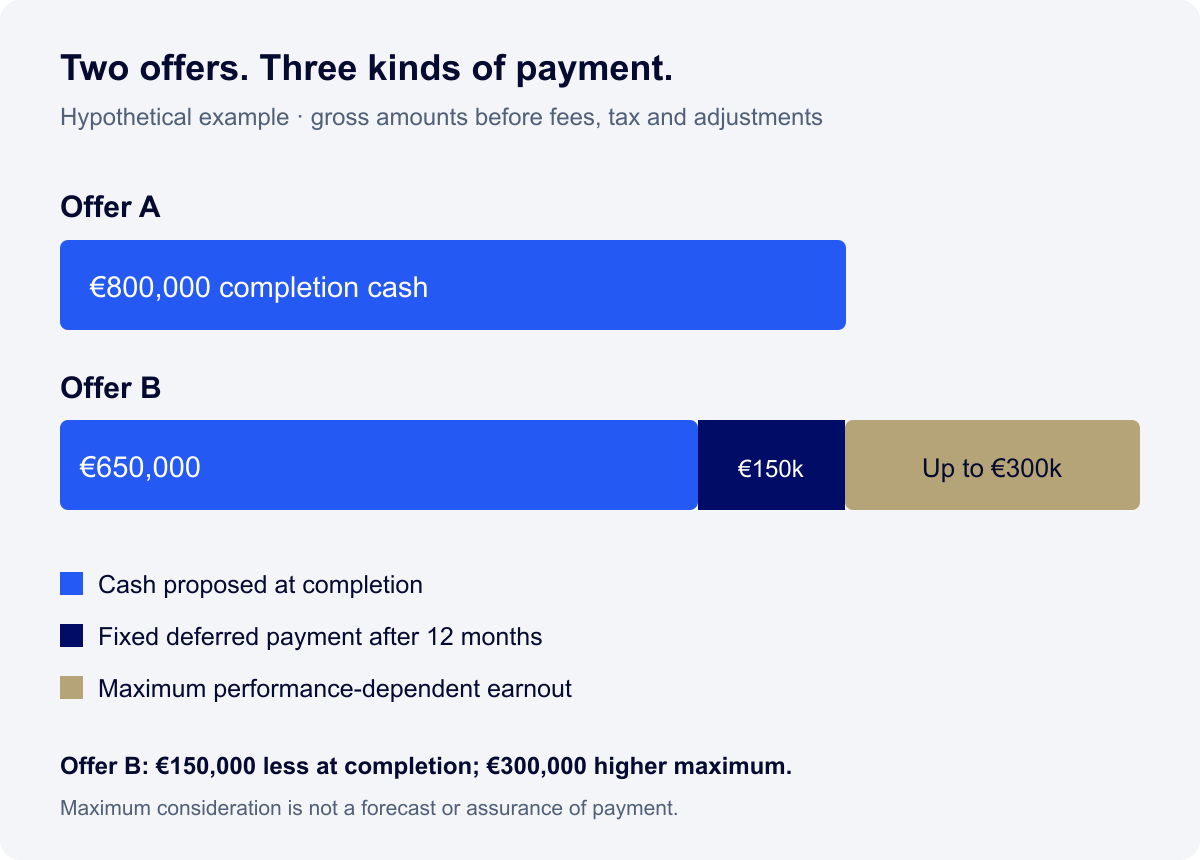
Offer B has a maximum price €300,000 above Offer A, but €150,000 less cash at completion. Its entire advantage in maximum nominal consideration comes from the earnout.
If Offer B's earnout were zero and its fixed deferred payment were paid in full, total nominal receipts would be €800,000. If the earnout paid €150,000 and the deferred payment were paid, receipts would be €950,000. At the full earnout, they would reach €1,100,000.
Those calculations do not assign probabilities, allow for the time value of money or establish whether later payments will be collected. “Fixed deferred” describes a proposed amount, not proof of the buyer's ability to pay. Offer A's completion cash also depends on the transaction reaching completion under the agreed terms.
Keep these three views beside each other: completion cash, later fixed payments and the range of contingent outcomes. Do not turn the maximum into your base plan by accident.
Calculate what would actually be available to you
The table compares gross consideration. Your personal plans require a separate calculation of proceeds after the relevant deductions and obligations.
For each offer, ask your advisers to work through the applicable price adjustments, debt or other amounts to settle, transaction costs, taxes and any money retained pending later release. Record when each item affects cash and which assumptions remain unresolved.
Avoid applying the same assumed net percentage to both offers. A fee may be calculated on particular types of consideration or become payable at a different point from the corresponding buyer payment. Tax treatment also needs advice for the actual transaction and your circumstances.
The useful output is a dated view of amounts potentially available for your plans, with conditional receipts clearly separated. You may discover that a proposal meets your preferred headline number but leaves too little available when you need it.
Compare the work attached to the money
Suppose, in this hypothetical example, Offer A requests a defined knowledge handover. Offer B asks you to continue managing operator relationships and reporting throughout the earnout period.
That difference matters if your reason for selling is to leave daily operations. It may matter less if you enjoy the commercial role and want to stay involved. Neither preference is wrong; it should be visible before the decision.
Write down the duties, hours or availability, authority, compensation and endpoint for each proposed role. Ask what happens if the buyer changes strategy or integrates the business into its own operation. Being asked to help achieve a target does not automatically give you control over the decisions affecting it.
An earnout calculation and an employment or consultancy arrangement need their own review. Do not let either one serve as an assumed description of the other.
Test whether the buyer can execute the proposal
A buyer's previous acquisitions can help frame questions, but you still need evidence for this transaction. Ask who makes the decision, what funding is available, which approvals remain and how the proposed diligence process would work.
For an affiliate sale, identify which operator relationships or third-party approvals require attention. For an operator or supplier, ask the relevant specialists to establish the regulatory, contractual and technical steps for the particular structure. Mark unresolved conditions explicitly instead of assuming they will be routine.
Ask both buyers for a practical sequence: the next information request, the decision it supports, the person responsible and the proposed date. A target completion date becomes more useful when the steps behind it are visible.
Before signing a letter of intent or accepting exclusivity, have counsel review the actual wording and obligations. Keep the commercial comparison available during that review so the consequences of proposed terms remain clear.
Make a short decision sheet
For each proposal, complete these six lines. Where information is missing, write “unresolved” and assign a next action.
| Decision area | What to record |
|---|---|
| Scope | Assets or shares included, obligations retained and adjustments requiring review. |
| Receipts | Completion cash, fixed later payments and contingent outcomes, separately. |
| Execution | Funding evidence, remaining approvals, diligence plan and dependencies. |
| Future work | Responsibilities, authority, availability, compensation and endpoint. |
| Personal fit | Which of your three main exit goals the proposal supports or conflicts with. |
| Next discussion | The missing term or evidence most likely to change your preference. |
Then write a provisional conclusion in one sentence. For example: “Offer A fits my wish to step away, subject to funding and completion terms; Offer B needs a clearer earnout and a smaller ongoing role before I can prefer it.” This is a hypothetical decision note, not a recommendation to favour upfront cash in every sale.
Your conclusion may change as evidence arrives. The purpose is to make that change deliberate and explainable. See how Bravio helps sellers compare competing offers.
Chapters 7 and 12 of The iGaming M&A Handbook develop payment structure and negotiation; Chapter 20 addresses multiple offers. You can explore the contents and request a complimentary PDF.
If you would like help organising the commercial questions around an offer, you are welcome to contact me privately. A brief outline of the choices you are facing is enough to begin.